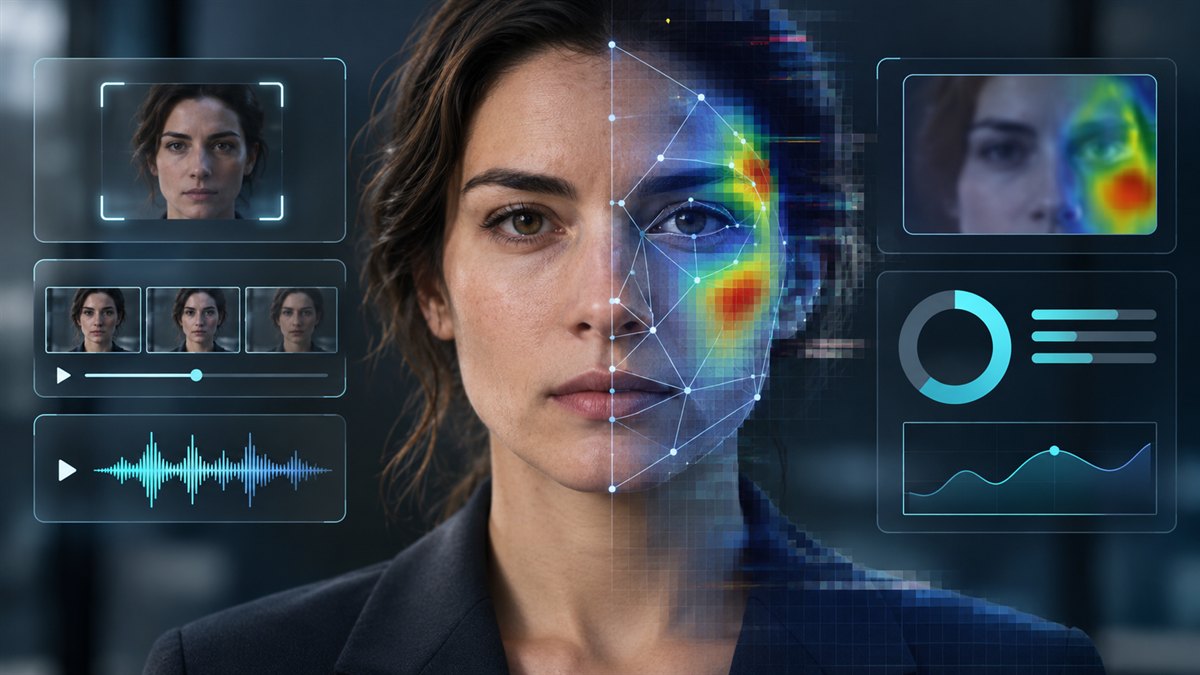
The main conclusion of the study is that despite significant progress in technologies for detecting fake content created with artificial intelligence, there is a significant gap between the performance of detection systems under laboratory conditions and their ability to handle fakes in the real world.
Study details
Study title: Deepfake detection in the era of generative AI: a systematic review, research challenges, and future direction
Researchers: Hanadi S. Alharbi, Ayman Noor, Ghada Alharbi, Talal H. Noor
Journal: Artificial Intelligence Review, published by Springer.
Date the paper was accepted for publication: 5 November 2026.
1. Executive summary
Systems that show accuracy rates of up to 100% under controlled conditions may struggle significantly to detect content created with technologies they have not encountered before.
In addition, the researchers point to a fundamental problem: most systems focus on whether the content is real or fake, without providing a sufficient explanation for the determination, and without defining how to act on it.
The researchers propose moving from an approach of detecting fakes with an algorithm to a system-wide approach that includes information gathering, analysis, reliability assessment, decision-making and response.
2. Research methodology
This is a systematic literature review, in which 16 studies published between 2023 and 2025 were analyzed.
The researchers compared the detection systems using 15 criteria, including data sources, training methods, types of fakes, algorithm performance, the ability to handle new fakes, system transparency and the ways of responding to findings.
The study does not present a new detection tool. Instead, it critically analyzes the state of the technology and the gaps that exist in it.
3. Main findings
a. The gap between laboratory performance and the real world
• Accuracy under controlled conditions: 83%-100%.
• Drop in performance when moving to other datasets: 15%-25%.
The problem is that many systems learn to identify features unique to the datasets they were trained on, and not necessarily universal features of fake content.
In some cases, when the systems were exposed to fakes created with other technologies, the drop in performance was even more significant.
b. A focus on images instead of combined analysis
Distribution of the content types examined in the studies:
• Images: 50%.
• Frames from video clips: 31.2%.
• Audio and video combined: 12.5%.
• Images, audio and video combined: 6.2%.
Source: Figure 4 in the paper, p. 20, based on the 16 studies examined.
The researchers believe that relying on images alone limits detection capability. Combined analysis may make it possible to detect mismatches between lip movements and voice, between intonation and facial expressions, and between different frames in the same video.
However, combining several types of data does not in itself guarantee better performance, because it requires high-quality synchronization between the data sources.
c. Most studies are not based on real-world content
Data sources used by the researchers:
• Open research datasets: 81.2%.
• Social networks: 12.5%.
• Combined sources: 6.2%.
Images and videos distributed on social networks undergo compression, resolution changes, cropping, editing and re-encoding. These processes may erase some of the digital markers that detection systems rely on.
As a result, a tool that succeeds in detecting a fake in the original file may fail to detect the same fake after it has been distributed on a social network.
d. Lack of transparency and decision-making processes
In my view, this is one of the most important findings in the study.
• Settled for a binary classification of real or fake: 81.2% of the studies.
• Did not provide a confidence score for the determination: 56.2% of the studies.
• Did not provide a mechanism for explaining the result: 43.8% of the studies.
• Did not define a response strategy after detection: 100% of the studies.
• Did not provide information on deployability in a work environment: 93.8% of the studies.
In other words, none of the 16 systems examined presented a structured response process after the fake was detected.
The researchers stress that determining that content is fake is not enough. It is necessary to understand what exactly was faked, where the manipulation was made, what evidence the determination is based on, how much confidence there is in it and what needs to be done as a result.
4. Notable examples from the studies examined
• DeepFeatureX-SN: accuracy of 97.29% in the main test, compared with 67.4% in a generalization test on other data.
• Deepfake-Eval-2024: detection performance in terms of AUC fell on average to about half compared with previous tests.
• AVFF: accuracy of 98.6% in combined audio and video analysis on the FakeAVCeleb dataset.
• SIDA: detection of fake images, marking of the manipulated area and a textual explanation.
• DeepFake-Adapter: an improvement of 3-6 points in the AUC metric in generalization tests.
• MultimodalTrace: accuracy of 92.9% on the main dataset, compared with 70%-83.61% on other datasets.
It is important to stress that the results were obtained under different experimental conditions and on different datasets, so the list should not be read as a comparative ranking of the quality of the systems.
5. The model the researchers propose
The researchers propose a framework made up of three complementary layers, as shown in Figure 2 on page 9 of the paper.
First layer - collection and monitoring: gathering information, reviewing sources, checking quality, filtering and preparing the material for analysis.
Second layer - detection and analysis: running algorithms, locating manipulations, analyzing mismatches and evaluating detection performance.
Third layer - decision and response: assessing the level of confidence, explaining the findings, human verification, producing a report and making decisions according to the level of risk.
The researchers' main innovation is giving significant weight to the third layer, which currently receives relatively little attention in research.
In cases where the confidence level is low or the possible implications of the finding are serious, the researchers recommend including a human element in the verification process.
6. Recommended directions for future research
• Generalization - developing systems that can also detect fakes created with models that were not used to train them.
• Continual learning - updating detection systems in line with the development of fake-generation technologies.
• Multimodal analysis - combining image, audio and video, and cross-checking the information between them.
• Explainable artificial intelligence (XAI) - presenting the evidence and the features that led to the determination that the content is fake.
• Robustness to data processing - improving detection capability even after compression, resolution changes and added noise.
• Standardization - creating uniform metrics and protocols for assessing the reliability of detection systems.
• Privacy protection - developing training and analysis methods that do not require sharing raw personal data.
• Integrating response mechanisms - connecting detection systems to work, reporting, verification and decision-making processes.
7. Limitations of the study
Alongside its importance, it should be kept in mind that this is a review of only 16 studies, selected according to defined criteria.
The review does not include systems dedicated to detecting audio-only or text-only fakes. In addition, it does not include a comprehensive examination of all the commercial products on the market, and the studies it includes were published up to the end of 2025.
Therefore, no definitive conclusions should be drawn from it about the performance of all the detection systems that exist in November 2026. The framework and the generalization metric that the researchers propose also require further validation.
8. Practical implications for OSINT and integrity screening
From this point on, this is my professional interpretation of the study and its implications for the work of analysts.
In the field of background checks, identity verification and the prevention of insider threats, the study reinforces the need to treat Deepfake detection tools as decision-support tools and not as the deciding factor.
Even when a commercial system shows a 99% probability that an image is fake, this does not necessarily mean that there is a real 99% probability that it is a fake. This depends, among other things, on how the system is calibrated, the data it was trained on and the type of content examined.
Therefore, in a professional check I would recommend combining several measures: different detection tools, reverse image search, locating the original source of the content, examining the context and the timeline, checking consistency against additional information sources, and human analysis of the findings.
Particular care is needed with false positives, since a mistaken determination that something is fake may damage a person's credibility or lead to a job candidate being disqualified.
The bottom line: the challenge today is not only to detect fake content, but to know how far the detection can be trusted, to explain the basis for the determination and to translate it into a professional, evidence-based and proportionate decision. This is the difference between a technological tool for Deepfake detection and a professional process for verifying information.