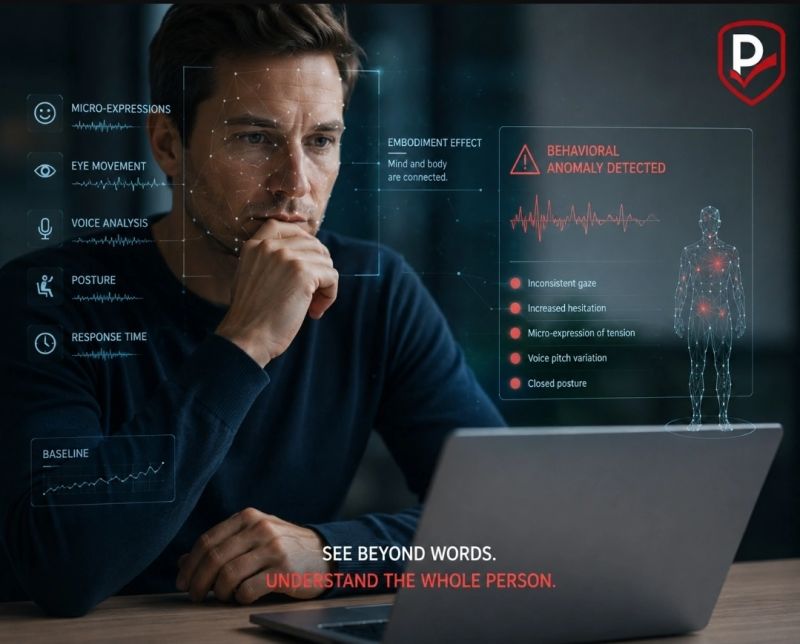
One of the most fascinating topics in the world of human behavior is the Embodiment Effect.
The core idea is simple but very profound: our body does not merely "express" emotions and thoughts, it also influences them, and sometimes even reveals them before the brain manages to control the message.
For years, body language was viewed as an "add-on" to communication. Today it is already clear that it is part of the thinking system itself. Sitting posture, hand placement, breathing rate, head movements, distance from the camera, use of space, micro-expressions, vocal changes, and even the manner of typing are all part of a behavioral information system.
In business profiling this is critical.
When we conduct a reliability assessment or try to identify the potential for an internal threat within an organization, we are not looking only for a "lie." It is far more complex. We are looking for incongruence.
The Embodiment Effect makes it possible to understand when physical behavior is not synchronized with the narrative a person is trying to produce. For example: a candidate who speaks confidently but whose body is in continuous defensiveness; an employee who declares commitment to the organization but reacts physically with stress when issues of authority, control, or loyalty arise; a manager who presents stability but shows abnormal signs of arousal around financial questions or internal conflicts; a remote candidate who produces "too perfect" eye contact, with an artificial response pace and communication patterns that suggest the use of external aids or real-time AI.
And here the new challenge enters: remote assessment.
In the era of hybrid work and Zoom interviews, some people think it is possible to "hide" behavior through a screen. In practice, the opposite sometimes happens.
The camera reduces background noise and forces us to focus on micro-behaviors: response delays, tone changes, eye darting, over-adjustments, unnatural listening, disconnects between voice and expression, motor freezing, and excessive use of calculated gestures.
Precisely in a remote environment, when you know what to look for, you can identify very significant indications of reliability, stress, concealment, manipulation, or internal conflict.
But it is important to state the professional truth: there is no "magic sign" that proves a lie. This is one of the biggest mistakes in the field.
Professional profiling is not built on myths of "touching the nose = lying." It is built on creating a behavioral baseline, identifying anomalies, cross-referencing information sources, analyzing context, understanding motivations, and reading dynamics rather than just isolated signs.
The Embodiment Effect is especially important in identifying internal threats within organizations, because people can control their words far more than their bodies. And in situations of stress, conflicting loyalties, a sense of threat, or concealment, the body almost always "leaks" information.
The future of the world of business profiling will not be based solely on technology nor solely on human intuition. It will be a combination of deep behavioral understanding, digital analysis, the use of OSINT, anomaly detection, and the human ability to read people even through a screen.
Because in the end, even in the era of AI, a person still leaves a behavioral signature.