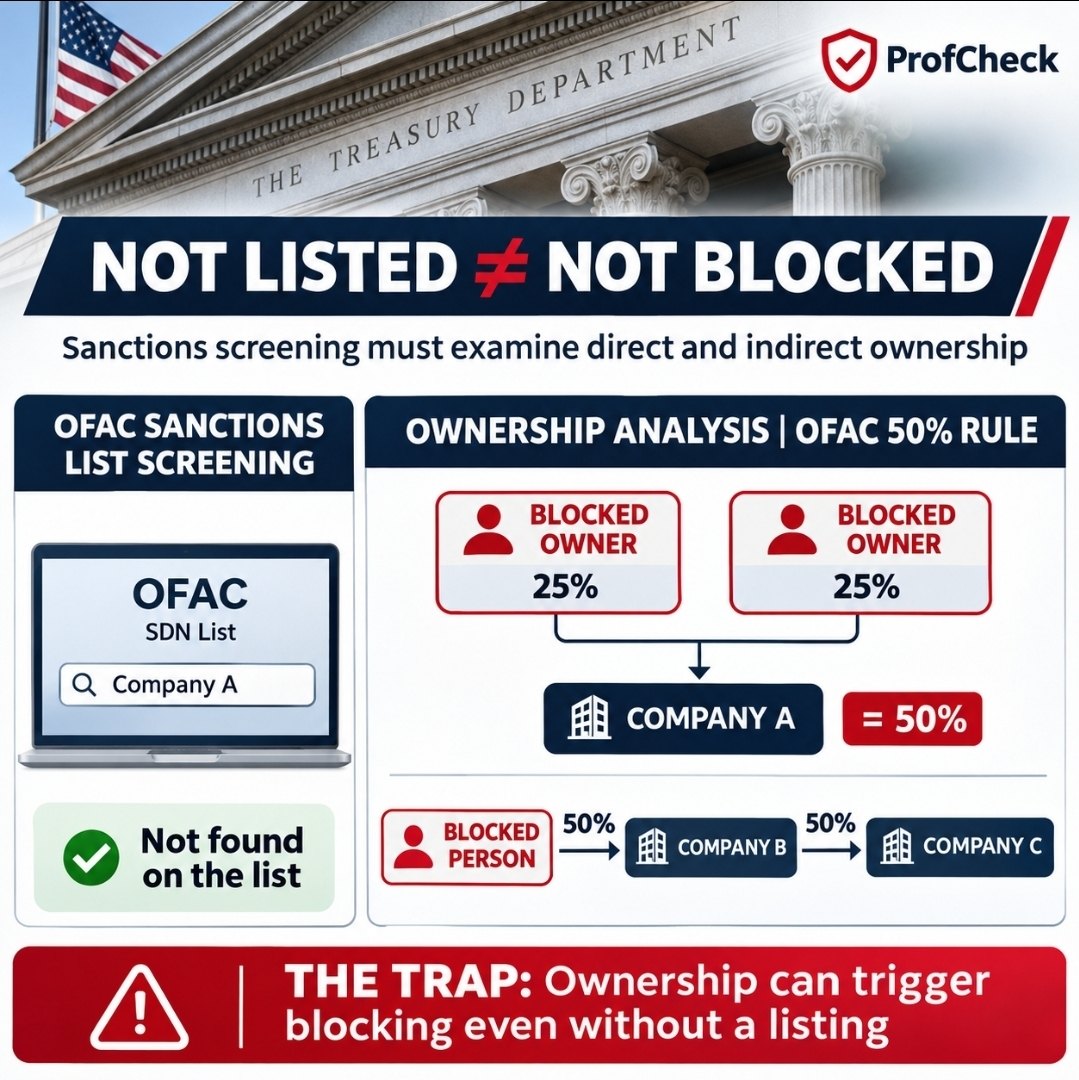
Picture a simple scenario. A company is about to sign with a new supplier. As part of onboarding, the supplier is screened against the sanctions lists of the US Treasury's Office of Foreign Assets Control (OFAC).
The supplier's name is not on the list.
Neither are the names of its directors.
The check is marked clear and the supplier is approved.
But nobody asked one important question: who really owns the company, and who owns the companies that own it?
That is exactly where the problem begins.
In August 2014, the US Treasury updated its guidance on companies owned by sanctioned parties.
The principle, known as the 50 Percent Rule, is fairly simple:
A company is considered blocked if one or more blocked persons own 50% or more of it, in the aggregate, directly or indirectly.
This holds even if the company's own name does not appear on the sanctions list at all.
To see what this means in practice, here are two examples.
Example 1: aggregated holdings
A sanctioned person owns 25% of Company A.
Another person, also sanctioned, owns a further 25%.
Neither of them controls the company, but together they own 50% of it.
For OFAC, the company is blocked.
The rule applies even when the two shareholders are designated under entirely different sanctions programs.
Example 2: indirect ownership
A sanctioned person owns 50% of Company B.
Company B owns 50% of Company C.
Company C is also blocked, even though its name does not appear on the sanctions list.
And here there is another distinction worth understanding.
Ownership and control are not necessarily the same thing.
A sanctioned person can control a company in practice without owning 50% of its shares.
Under OFAC's 50 Percent Rule, control on its own does not automatically make the company blocked.
But that certainly does not mean every dealing with it is permitted.
For example, as a rule, a US person may not enter into a contract that a blocked person signs on behalf of a non-blocked company, unless appropriate authorization exists.
OFAC also advises caution when blocked persons own less than 50% of a company or exercise control over it in other ways.
So what does this mean for due diligence on suppliers and business partners?
• It is not enough to check whether the company's name appears on the sanctions list. You need to identify its shareholders and examine the ownership chain, layer by layer.
• It is not enough to check each shareholder separately. You need to add up the holdings of all blocked parties.
• It is not enough to check direct ownership. Indirect ownership can also result in the company being blocked.
• It is not enough to know who owns the company. You also need to check who represents it and who is authorized to sign on its behalf.
• Above all, be precise in your conclusions. "No match found on the sanctions list" is not the same conclusion as "the company is not subject to sanctions".
An important caveat: OFAC's rules apply mainly to US persons and to activity within US jurisdiction. Some sanctions programs carry additional restrictions, and other countries may apply different rules.
And there is one more limitation worth knowing.
Even a thorough background check based on open-source intelligence (OSINT) depends on information that can be found.
It is possible to analyze ownership structures, identify shareholders, trace holding chains and cross-check the results against sanctions lists.
But no one can guarantee the detection of hidden ownership that is not documented in any accessible source.
That is why a sanctions check is part of due diligence. It is not a substitute for due diligence.
The next supplier that exposes your organization to sanctions risk will not necessarily appear on the sanctions list.
It may appear instead in its own ownership chart, a few layers below the surface.