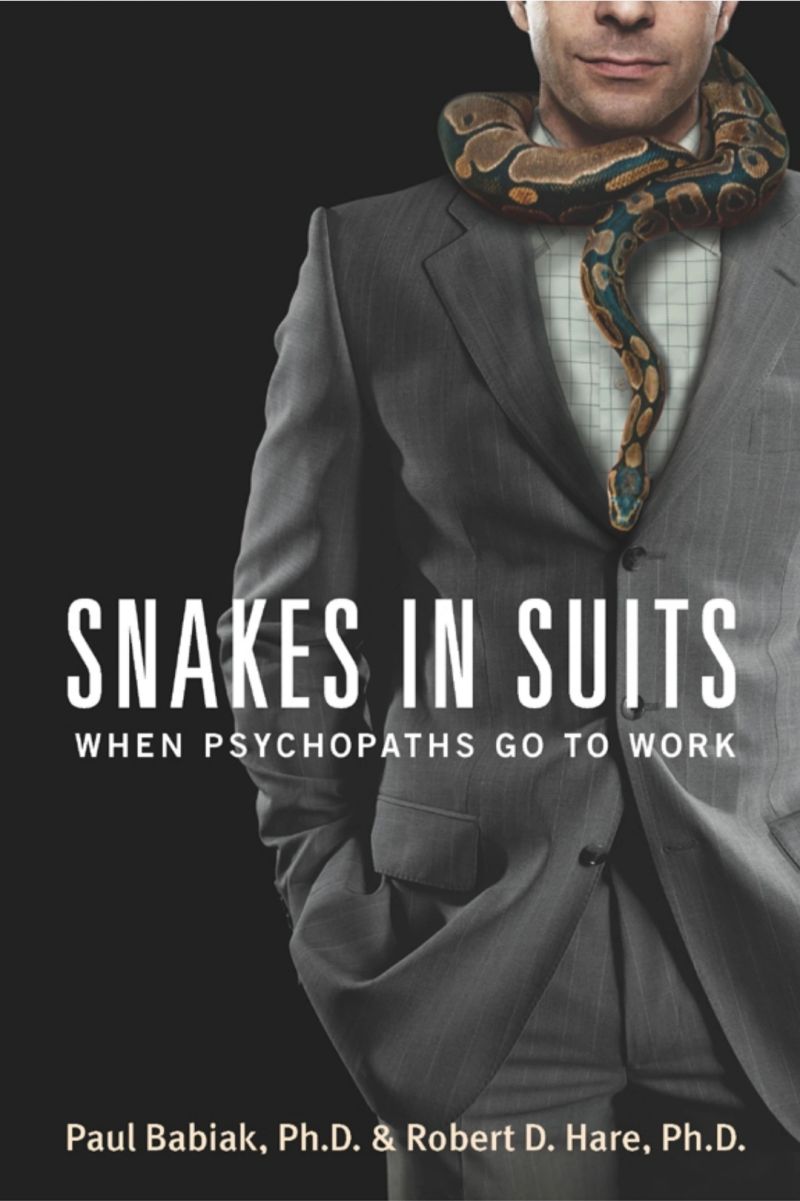
One of the most disturbing books we have read recently in the field of organizational behavior is "Snakes in Suits: When Psychopaths Go to Work" by Paul Babiak and Robert Hare.
The book deals with the kind of people that most organizations don't really know how to identify in time. Not violent criminals. Not extreme characters from movies. Rather charismatic, impressive, sharp people, with an extraordinary ability to make others believe in them.
It is precisely because of this that they are dangerous.
The authors describe how an organizational psychopath manages to fit into an organization, advance quickly, accumulate power and influence, and along the way leave behind enormous damage: the breaking up of teams, the creation of conflicts, political manipulations, intimidation of employees, harm to trust, the creation of a toxic culture, and at times also fraud and abuse of authority.
What is particularly interesting is that the book explains that the problem is not only with the person himself. At times the organization also contributes to it without realizing it.
Organizations that sanctify charisma, fast results, aggressiveness, achievement at any cost, and internal politics, may mistakenly identify psychopathic behavior as "leadership".
One of the important things in the book is the description of the three stages in which an organizational psychopath operates.
In the first stage he studies the system: who is strong, who is weak, who is influential, who is threatened, who has access to power and information.
In the second stage the manipulation begins: flattery, the creation of false trust, adapting his personality to each individual, sophisticated lies, and quiet harm to rivals.
In the third stage comes the abandonment: when the person is no longer useful, he is thrown aside. Sometimes also with deliberate harm to his reputation.
The most important part for me is the understanding that it is not always possible to identify such people through charisma or first impression. On the contrary.
In many cases they are calm under pressure, know how to speak convincingly, project self-confidence, know how to "read people", and imitate empathy excellently.
And therefore in the world of Insider Threats, employee recruitment, and reliability assessment, one must not rely only on intuition or a "gut feeling".
One must examine: behavioral consistency, gaps between words and actions, patterns of manipulation, attitude toward people without power, history of conflicts, and repeated use of victims, accusations, and politics.
This book is an excellent reminder that the most dangerous threats in an organization don't always come from outside.
Sometimes they are sitting in the boardroom.